
Plant Ally: Chicory
Cichorium Intybus
Background
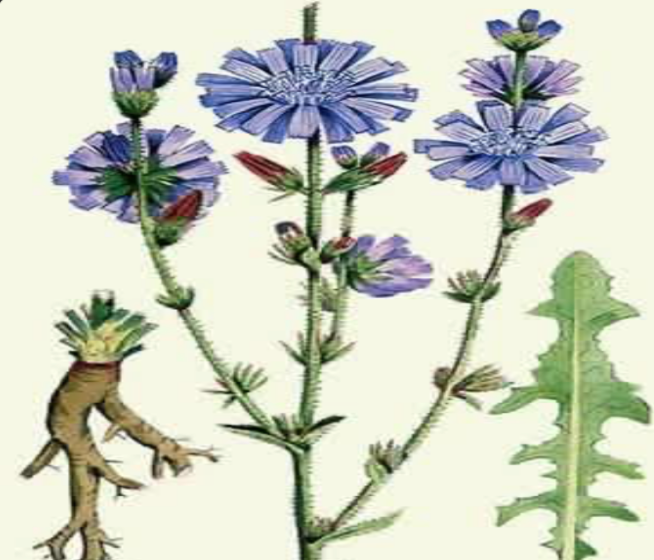
A small but mighty biennial plant. At times mistaken for a weed or Dandelion root. It has similar toothed leaves that grow untamed along disturbed roads. Chicory showcases those jagged leaves within the first year of sprouting. In the following years, it shoots up hairy, green stocks that can grow up to 3 feet tall, sprouting mesmerizing, deep blue to purple flowers. One rarely finds flowering pink or white Chicory.
Although not native to North America, Chicory is a strong force that has found its way through all parts of the world, originating in Eurasia and naturalized in North America. Much to its resilience, you can find it in underkept soils and between the cracks of cement and old home fences. Chicory is a friend to many cultures and wears many faces. Chicory’s story dates back to ancient Egypt, where it was valued for its ability to detoxify the body and empower the spirit.
Looking at its Botanical name, Chicory is in the same family as the leafy green Endive and can be used interchangeably for the same purpose as a vegetable in salads. Other places, like France, recognized its hairy ‘beard-like’ leaves and called it ‘Capuchin’s beard.’ All the same, Chicory has been used for medicinal purposes, culinary applications, and ritual practices. Here are a few aliases chicory has around the world: “Succory; Gum Succory; Spouse of the Sun; Blue Dandelion”
The love that has always followed Chicory was its use as a coffee replacement. During times of war, Chicory was a helpful ally that helped ration coffee or even replace it entirely. Resource and food shortages led to Coffee being seen as scarce and too expensive. Chicory became an herb of frugality. Taking a liking to the robust taste of Chicory, it has been incorporated in many coffee roasts to this day. Roasted chicory is nutty and has hints of woodsy aroma, while the raw root is more bitter. You can use all parts of this plant; more commonly favored are the leaves and bitter root.
Being bitter hints at the potential benefits of Chicory. Bitters help stimulate the gastrointestinal tract through the production of more gastric mucosa and release blood supply to digestive organs, aiding in the overall functions of our digestive system, which is helpful for slower digestion or a backed-up tract. Chicory can serve a wide range of benefits when incorporated into your home apothecary.
Benefits/ Uses
- Bitter
- Hepatoprotective
- Laxative
- Vulnerary
- Neuroprotective
- Anti-fungal & Anti-bacterial
Constituents
Before we unpack the amazing workings of Chicory, we must understand the herbal constituents that work in silence.
Inulin- a type of dietary fiber that is digested in the large intestine and gives healthy gut bacteria. An excellent source of nutrients that supports our digestive tract. Alongside, a precursor to the production of bile strengthening the function of our liver
Caffeic Acid- Not to be confused with Caffeine, but a variant of polyphenols that are antioxidant to both our gut and brain. CA has a molecular structure that identifies the unpaired electrons and effectively traps them. Watering down the radicals with hydrogen, stabilizes the unpaired electrons before it can breakdown into harmful radicals in the body.
Chicoric Acid- Powerful Anti-viral & Anti-Bacterial. Studies have shown an active response to gram-negative bacteria and the inhibition of viral DNA replication. Chicoric Acid has strong immunomodulatory effects that strengthen the immune response to viral/ bacterial enemies. Also, stimulating our phagocytosis (which ingests and digests foreign invaders, like bacteria or dead cells) acts as a strong ally to our immune system.
Curiously, Chicoric Acid has been used to decrease the levels of hepatic glycogenesis, a secondary method of making glucose in the liver. By suppressing its release, it can help lower blood sugar levels, especially for those with strong insulin resistance.
Sesquiterpene lactones– Specifically, 8-deoxylactucin & Lactucopicrin are higher metabolites in chicory’s plant matter. We can thank Lactucopicrin for the bitter taste of Chicory. Some studies show Lactucopicrin can be a potent inhibitor of Acetylcholinesterase (ACHE), the enzyme that stops the initial signaling for mind-body synapses. Doing so allows for a continuous connection between mind and body signals. This is needed for those with neurodegenerative diseases, where acetylcholine (a chemical messenger in our Nervous system) is weaker. Additionally, both lactones affect the production of Neurophins (proteins that are essential for the integrity and growth of neurons). These strong components support Chicory as a potential neuroprotective.
CLEANSING NATURE
Acting as a strong tonic for your liver. Chicory may stimulate your body’s own natural processes. This plays a crucial role in waste elimination and the overall breakdown of fatty foods. When working with the root, Chicory can strengthen the gallbladder by dissolving any thick blockages or buildup of bile, allowing it to resume its process of storing and moving waste throughout the intestines. The roots, seeds, and leaves are considered to have cleansing action of the plant.
Working to support a healthy digestive system, this plant contains Inulin. This specific fiber cannot be broken down in the small intestine. Instead, it moves directly to the large intestine and ferments there, giving you beneficial stomach bacteria. Improving our digestive system and promoting better nutrient absorption.
TOPICAL APPLICATIONS
By understanding Chicory’s strong anti-viral, anti-bacterial profile, we can apply the same benefits to our skin. The milky sap obtained from a cutting of its stem has been used to treat insect bites. In parts of Iran, they use it to treat warts. In Afghanistan, it’s used to combat Malaria. A decoction of the aerial parts has been used to treat hemorrhoids and eczema—extracts of the plant, such as sesquiterpene lactones and phenolic acids, were found to be the stars in healing skin ailments or general skin irritation. Chicory not only works to defend the root cause of many skin complaints but also helps reduce swelling and itchy-like symptoms. Don’t be afraid to add it to a salve; Chicory will enhance the soothing nature of any other complementary herbs. You can include the aerial parts of chicory in a salve or balm. I suggest you work with the ash of the root, which contains higher amounts of named constituents.
NEUROPROTECTIVE BEVERAGE
How can I do Chicory justice without mentioning its use as a coffee mimic? I don’t dare call it a replacement because it doesn’t contain caffeine, which is the main neuro-centered stimulant that gives you the effects of more alertness and less fatigue. Chicory, on the other hand, does have mild compounds of Caffeic acid. A non-stimulating phenolic compound that has neuroprotective properties to boost brain function and other anti-inflammatory actions in the body. Consider adding Chicory into blends that focus on the integrity of your nervous system. This herb plays the long game by aiding in the production of Nerve Cell Growth, building your mental stamina versus providing instant energy. Chicory is suited for those looking to restrict their caffeine intake while also strengthening their nervous system. Similar to Dandelion Granules, the combination of the two can be a powerhouse to mimic the taste and effects of coffee with consistent use.
ENERGETICS OF CHICORY
Chicory is an abundant herb that has bounced around many cultures throughout time. Our love for it exists today, in the medicinal aspect and craft side of our plant world. When looking to learn about the essence or gifts of plants, there are a few things we can consider. We can look at the historical/ folklore uses of the herb, keeping in mind the culture you are learning from, or we can observe the plants growing pattern and overall medicinal profile. Our understanding of an herb becomes stronger when we take from each of these and develop our own connection or meaning based off those perspectives. Sitting and listening with our energetic bodies vs our mind goes a long way, when communicating with plants. It’s the language they use, and their more receptive to that approach. Plants can be our friends and healers just as they can be punishing and poisonous. Always take precaution and come with a basic knowledge of the herb you’re looking to connect with. Lean into the calls of the herbs that itch at you and be respectful to their habitat and neighboring plants as you get to know them.
Looking at the base of Chicory’s growth pattern and practical uses in the past, we can associate it with energies or situations relating to frugality, blockages, and invisibility. Chicory has been used to ration coffee and as medicine in replacement of other deprived sources during times of war and hardship. It’s been seen to help one learn to be frugal when working towards something greater. Be it your material success, or personal development. Every time I’ve walked alongside it, I’m amazed at how unassuming this resilient plant is, being able to grow strong in almost every environment I’ve stumbled upon it. In my time with chicory, it has shown up as a teacher, helping to see the obstacles in my life, as tools that can later come to benefit me. Whether it be a shift of outlook on a situation, learning to adapt or even paying closer attention to the physical resources at hand. Chicory has asked us to look beyond the surface and see how we can optimize our resources or even tap into the potential of our inner strength to turn things in our favor.
As always seek the advice of your physician or other qualified health provider with any questions you may have regarding a medical Condition. Never disregard professional medical advice or delay in seeking it because of something you have read, heard, seen in our blog posts. 🙂